
Independent informational directory. Not affiliated with or endorsed by the Social Security Administration (SSA) or ssa.gov.
Instant Client-Side Decoder • 100% Private

SSN State Lookup & Area Code Decoder

Identify the state or territory where a Social Security Number was originally issued. Enter the first 3 digits (Area Number) to decode pre-June 25, 2011 issuance records instantly.

Anatomy of a Social Security Number

1. Area Number XXX Geographic State Code (Pre-2011)
2. Group Number XX Administrative Batch Pattern
3. Serial Number XXXX Sequential Order (0001-9999)

Client-Side Only: No numbers are transmitted to our servers or saved anywhere.

Important Federal Randomization Rule (June 25, 2011): Social Security Numbers issued on or after June 25, 2011 are entirely randomized across all available area codes. If a card was issued after that date, the Area Number no longer corresponds to any state or geographic territory. This tool applies to numbers issued between November 1936 and June 24, 2011.

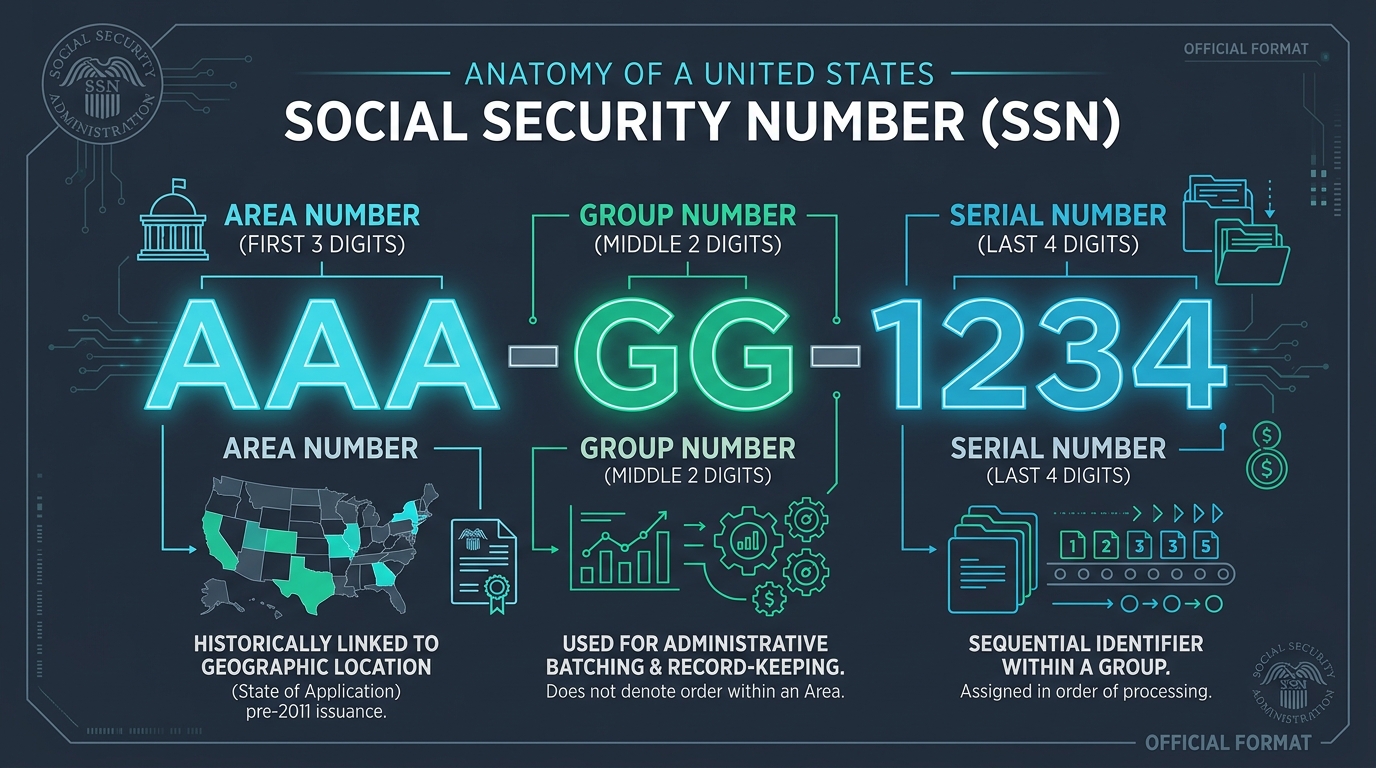
Social Security Number Anatomy Infographic

A visual overview of the 9-digit format: how the Area Number, Group Number, and Serial Number function in federal administration.

Infographic illustrating the anatomy of a United States Social Security Number: Area, Group, and Serial numbers
1. Area Number (Digits 1–3) Historically mapped to the postal zip code of the applicant's mailing address on Form SS-5. Numbers progressed generally from Northeast (001–003 NH) to West Coast (545–573 CA).
2. Group Number (Digits 4–5) Served as an administrative batch control. Group numbers were not issued sequentially; odd numbers 01 to 09 were distributed first to verify processing batches.
3. Serial Number (Digits 6–9) A consecutive 4-digit sequence running from 0001 through 9999 within each group. Group 00 was never used, and serial 0000 was never assigned.

Complete 50-State SSN Area Number Table

Historical federal allocation ranges for all 50 states, D.C., Puerto Rico, and U.S. territories.

State / Jurisdiction State Code Pre-2011 Area Number Range Census Region Office Directory
New Hampshire NH 001–003 Northeast View Offices →
Maine ME 004–007 Northeast View Offices →
Vermont VT 008–009 Northeast View Offices →
Massachusetts MA 010–034 Northeast View Offices →
Rhode Island RI 035–039 Northeast View Offices →
Connecticut CT 040–049 Northeast View Offices →
New York NY 050–134 Northeast View Offices →
New Jersey NJ 135–158 Northeast View Offices →
Pennsylvania PA 159–211 Northeast View Offices →
Maryland MD 212–220 South View Offices →
Delaware DE 221–222 South View Offices →
Virginia VA 223–231 South View Offices →
West Virginia WV 232–236 South View Offices →
North Carolina NC 232, 237–246 South View Offices →
South Carolina SC 247–251 South View Offices →
Georgia GA 252–260 South View Offices →
Florida FL 261–267, 589–595 South View Offices →
Ohio OH 268–302 Midwest View Offices →
Indiana IN 303–317 Midwest View Offices →
Illinois IL 318–361 Midwest View Offices →
Michigan MI 362–386 Midwest View Offices →
Wisconsin WI 387–399 Midwest View Offices →
Kentucky KY 400–415 South View Offices →
Tennessee TN 416–424 South View Offices →
Mississippi MS 425–428, 587–588, 752–755 South View Offices →
Arkansas AR 429–432, 654–658 South View Offices →
Louisiana LA 433–439, 659–665 South View Offices →
Oklahoma OK 440–448 South View Offices →
Texas TX 449–467, 627–645 South View Offices →
Minnesota MN 468–477 Midwest View Offices →
Iowa IA 478–485 Midwest View Offices →
Missouri MO 486–500 Midwest View Offices →
North Dakota ND 501–502 Midwest View Offices →
South Dakota SD 503–504 Midwest View Offices →
Nebraska NE 505–508 Midwest View Offices →
Kansas KS 509–515 Midwest View Offices →
Montana MT 516–517 West View Offices →
Idaho ID 518–519 West View Offices →
Wyoming WY 520 West View Offices →
Colorado CO 521–524 West View Offices →
New Mexico NM 525, 585, 648–649 West View Offices →
Arizona AZ 526–527, 600–601, 764–765 West View Offices →
Utah UT 528–529 West View Offices →
Nevada NV 530, 680 West View Offices →
Washington WA 531–539 West View Offices →
Oregon OR 540–544 West View Offices →
California CA 545–573, 602–626 West View Offices →
Alaska AK 574 West View Offices →
Hawaii HI 575–576, 750–751 West View Offices →
District of Columbia DC 577–579 South View Offices →
U.S. Virgin Islands VI 580 Territories Special Range
Puerto Rico PR 581–584, 596–599 Territories Special Range
Guam / Pacific Territories GU 586 Territories Special Range
Railroad Retirement Board RRB 700–728 Federal Program Special Range

Understanding Social Security Numbers: History, Geography, and Randomization

When President Franklin D. Roosevelt signed the Social Security Act into law on August 14, 1935, the federal government faced an unprecedented logistical challenge: accurately recording the earnings histories of tens of millions of American workers over their working lifetimes. The solution was the 9-digit Social Security Number (SSN), first distributed to the American public in November 1936.

1. How the 9-Digit Number Was Originally Designed

The nine-digit identifier is divided into three distinct segments formatted as AAA-GG-SSSS:

  • The Area Number (First 3 Digits): Allocated geographically based on the state where the initial application (Form SS-5) was processed. Beginning in New England with New Hampshire (001–003), numbers moved generally south along the Atlantic seaboard and westward across the continent, ending with Hawaii (575–576) and California (545–573, 602–626).
  • The Group Number (Middle 2 Digits): Administrative batch numbers ranging from 01 to 99. These did not denote the chronological order of cards issued within a state. Instead, they served to verify internal filing blocks in SSA central record-keeping offices in Baltimore, Maryland.
  • The Serial Number (Last 4 Digits): A straightforward sequential number running from 0001 through 9999 assigned within each group.

2. State of Application vs. State of Birth: A Common Misconception

One of the most persistent myths surrounding Social Security Numbers is that the first three digits indicate the cardholder's state of birth. In reality, prior to 2011, the Area Number reflected the state of the mailing address listed on Form SS-5 when the application was filed.

For individuals whose parents applied for their SSN at birth through the modern "Enumeration at Birth" (EAB) hospital program (which began in the late 1980s), the state of issuance often matches the birth state. However, millions of older Americans, naturalized citizens, and individuals whose families moved across state lines during early childhood carry Area Numbers representing the state where they attended school or took their first teenage job, rather than their birth state.

3. The Group Number Pattern Decoded

The SSA did not issue group numbers in simple consecutive order (01, 02, 03...). To detect clerical filing errors and balance file drawers, the administration issued group numbers in four specific waves within each Area Number:

Tier 1: Odd Numbers (01 through 09) The earliest group numbers issued in every state: 01, 03, 05, 07, 09.
Tier 2: Even Numbers (10 through 98) Issued next in consecutive even sequence: 10, 12, 14... up to 98.
Tier 3: Even Numbers (02 through 08) Issued third: 02, 04, 06, 08.
Tier 4: Odd Numbers (11 through 99) Final wave issued: 11, 13, 15... up to 99.

4. The June 25, 2011 Turning Point: SSN Randomization

By the late 2000s, two critical factors forced the Social Security Administration to overhaul number issuance:

  1. Geographic Depletion: High-growth states like Florida, Texas, and California were rapidly running out of unassigned numbers within their allocated ranges, while smaller states had millions of surplus unused combinations.
  2. Identity Theft & Predictive Algorithms: Because public records and birth certificates revealed an individual’s birth date and birth state, academic researchers demonstrated that bad actors could statistically predict a person’s complete 9-digit SSN with alarming accuracy.

In response, the SSA implemented SSN Randomization on June 25, 2011. Randomization eliminated the geographic significance of the Area Number, discontinued the publication of the highest group number issued, and made previously unassigned area numbers available for random allocation nationwide.

5. Special, Invalid, and Non-SSA Ranges

Several numerical ranges have unique federal designations or are strictly excluded from assignment:

  • Area 000: Never issued under any circumstances. Any 9-digit number starting with 000 is invalid.
  • Area 666: Excluded by administrative policy; never issued to the public.
  • Areas 900–999 (IRS ITINs): These are not Social Security Numbers. The Internal Revenue Service issues Individual Taxpayer Identification Numbers (ITINs) starting with 9 to individuals who are required to file U.S. tax returns but are ineligible for an SSN.
  • Areas 700–728 (Railroad Retirement Board): Prior to July 1963, railroad workers received numbers in the 700–728 range issued directly by the Railroad Retirement Board. After 1963, railroad workers were integrated into standard SSA field office enumeration.

6. Protecting Your Social Security Number from Fraud

Your Social Security Number is your most sensitive personal identifier. Scammers routinely make automated spoofed calls threatening arrest, claiming your SSN has been "suspended due to suspicious activity." Keep these official SSA security protocols in mind:

• The SSA will never suspend your Social Security number: SSNs are permanent and cannot be suspended or canceled.

• The SSA will never threaten arrest or deportation: Federal SSA personnel will never demand immediate wire transfers, gift cards, or cryptocurrency payments over the telephone.

• How to Report SSN Fraud: If you suspect identity theft or receive a fraudulent call, file a report immediately with the Social Security Administration Office of the Inspector General (OIG) at oig.ssa.gov or call 1-800-269-0271.

Frequently Asked Questions: SSN State Lookup & Area Codes

Common questions about geographic area allocations, pre-2011 records, and SSN randomization.

Can you tell what state someone was born in from their Social Security Number?

No. Prior to June 25, 2011, the first three digits (the Area Number) indicated the state or territory of the applicant’s mailing address when they submitted Form SS-5, not their birth state. While many infants were registered in their birth state, anyone who applied later in childhood, during a family relocation, or for their first job received an SSN coded to the state where the application was processed. For all numbers issued on or after June 25, 2011, the SSA randomized area numbers, eliminating geographic ties completely.

What is SSN Randomization and when did it begin?

On June 25, 2011, the Social Security Administration officially enacted SSN Randomization. This change eliminated geographic area number assignments, allowed previously unused area numbers to be allocated, and ceased publication of highest group numbers. Randomization was introduced to extend the longevity of the 9-digit SSN system and enhance personal identity security against algorithmic prediction.

What do the middle two digits (Group Number) of an SSN mean?

The middle two digits (01 through 99) are administrative batch identifiers called Group Numbers. They were not assigned in consecutive numerical order. Instead, the SSA issued group numbers in a specific four-phase administrative pattern: odd numbers 01 to 09 first, then even numbers 10 to 98, followed by even numbers 02 to 08, and finally odd numbers 11 to 99 within each geographic area.

Are Social Security Numbers starting with 000, 666, or 900 valid?

No. The Social Security Administration has never issued numbers beginning with 000 or 666. Furthermore, numbers beginning with 900 through 999 are reserved exclusively by the Internal Revenue Service (IRS) for Individual Taxpayer Identification Numbers (ITINs) and are never valid Social Security Numbers.

Is it safe to use this SSN State Lookup tool?

Yes, 100%. Our tool operates entirely on client-side JavaScript inside your web browser. No numbers are transmitted to our web servers, logged in databases, or shared with third parties. You do not need to enter your full SSN—entering just the first three digits is sufficient to identify the pre-2011 issuance jurisdiction.